Xayaburi Province sits along the Mekong River in northern Laos — fertile, tropical, and increasingly home to large-scale Chinese-invested banana plantations supplying China's domestic fruit market. But scale brings its own problems. A 10,000-acre banana operation cannot be managed with the same tools as a 100-acre family farm. The labor cost alone for manual irrigation across this footprint would erase the margin. The farm needed automation — and it needed it to work reliably in a remote, infrastructure-limited environment.
"Ten thousand acres is not a farm. It's a territory. You don't manage it with people — you manage it with data."
The Challenge: Irrigation at Mekong Scale
The Xayaburi plantation spans terrain that varies in elevation, soil composition, and proximity to the Mekong water source. Conventional flood irrigation — the default across most Lao banana operations — wastes enormous volumes of water, delivers nutrients inconsistently, and requires a large permanent field workforce that is increasingly difficult to retain. The farm operator needed a system that could:
- Deliver consistent moisture to every zone regardless of terrain
- Automate fertigation schedules based on banana growth stage
- Monitor the entire site remotely with minimal on-site staff
- Operate reliably in a low-connectivity, high-humidity tropical environment
The JJR Solution: Full-Stack IoT + AI Automation
JJR deployed its complete precision agriculture stack across the 10,000-acre site:
- Smart Drip Irrigation Network: Zone-controlled drip emitters replace flood channels across the entire plantation, delivering water directly to the banana root zone with minimal evaporation loss.
- AI Fertigation Controllers: Multi-channel automated fertigation units mix and deliver nutrient solutions on schedule, adjusting formulas automatically based on crop growth stage — vegetative, bunch emergence, filling, and pre-harvest.
- Distributed IoT Sensors: Soil moisture, temperature and EC sensors deployed across zones feed real-time data into the JJR Data Farm platform, triggering irrigation only when and where the crop needs it.
- Environmental Monitoring: Weather stations and humidity sensors provide localized microclimate data across the large site footprint — critical for a crop as climate-sensitive as banana.
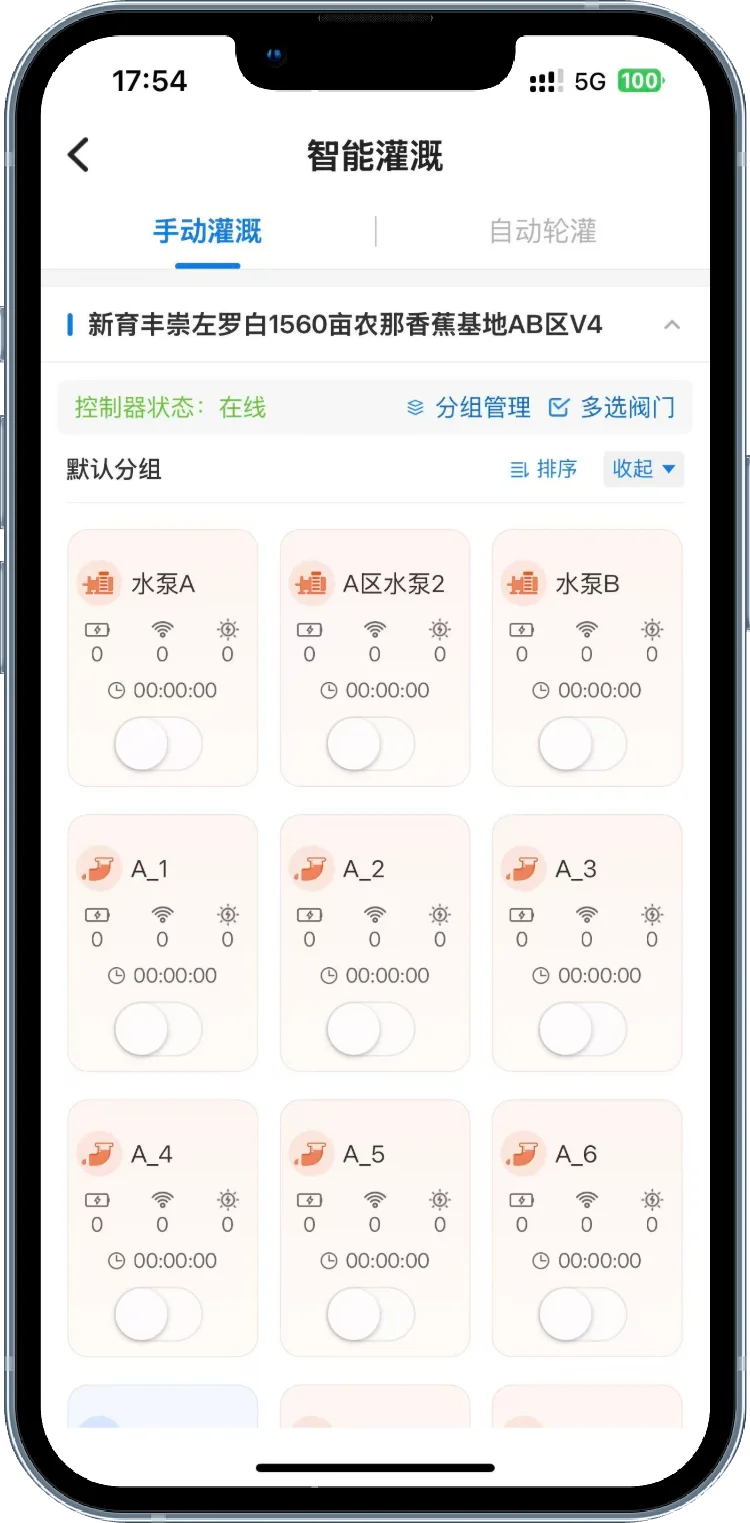
- Data Farm Mobile Platform: The plantation management team monitors all zones, reviews AI-generated daily crop advisories, and triggers manual overrides from a single mobile app — whether in Xayaburi or Vientiane.
Before vs. After Implementation
Before JJR
- Flood irrigation — high water waste
- Manual fertilizer application across vast acreage
- Large permanent field workforce required
- No real-time visibility across zones
- Variable bunch weight & grade rates
After JJR
- Precision drip — 30% less water consumed
- Automated stage-based fertigation
- 60% reduction in irrigation labor
- Live zone monitoring from mobile app
- Consistent bunch weight & improved export grade
A Blueprint for Mekong Region Agriculture
The Xayaburi project has become a reference point for large-scale plantation modernization across the Mekong region. Chinese-invested banana operations in northern Laos, northeastern Thailand, and Cambodia face identical challenges — vast acreage, limited local labor, and distance from management teams. JJR's system architecture is directly replicable across all these contexts, with site-specific calibration for local soil and climate conditions.
For Southeast Asian plantation operators, the Xayaburi project demonstrates a concrete answer to the region's most pressing agricultural challenge: how to scale production without scaling headcount.